Featured in C-Ville Weekly – March 12, 2014
A Gentle Touch
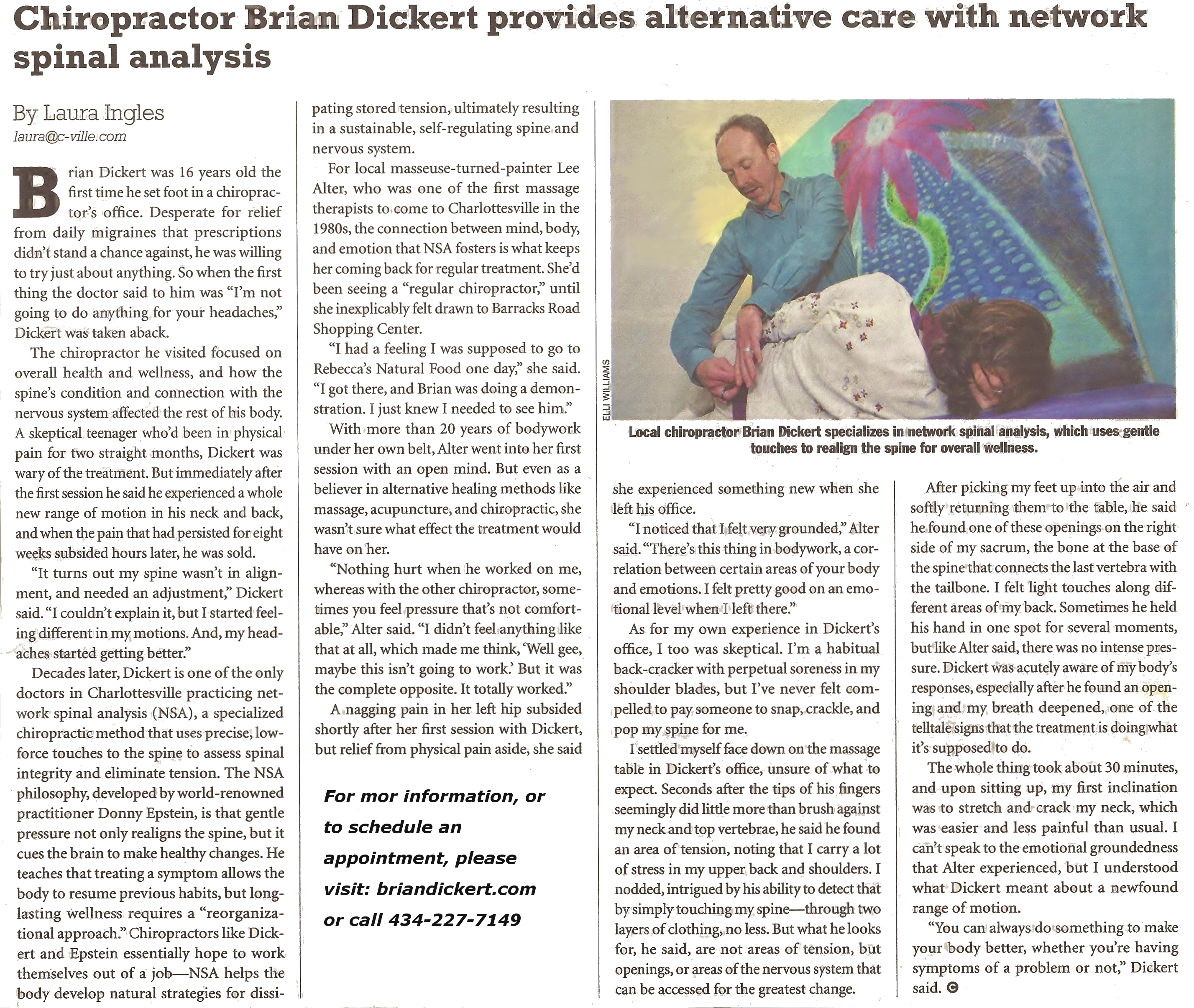
Featured in C-Ville Weekly – March 12, 2014
A Gentle Touch
Thanks for searching for more information about my office.
As a thank you for your curiosity, I would like to extend a special offer of $50 for my initial consultation. Please call or text 434-227-7149.
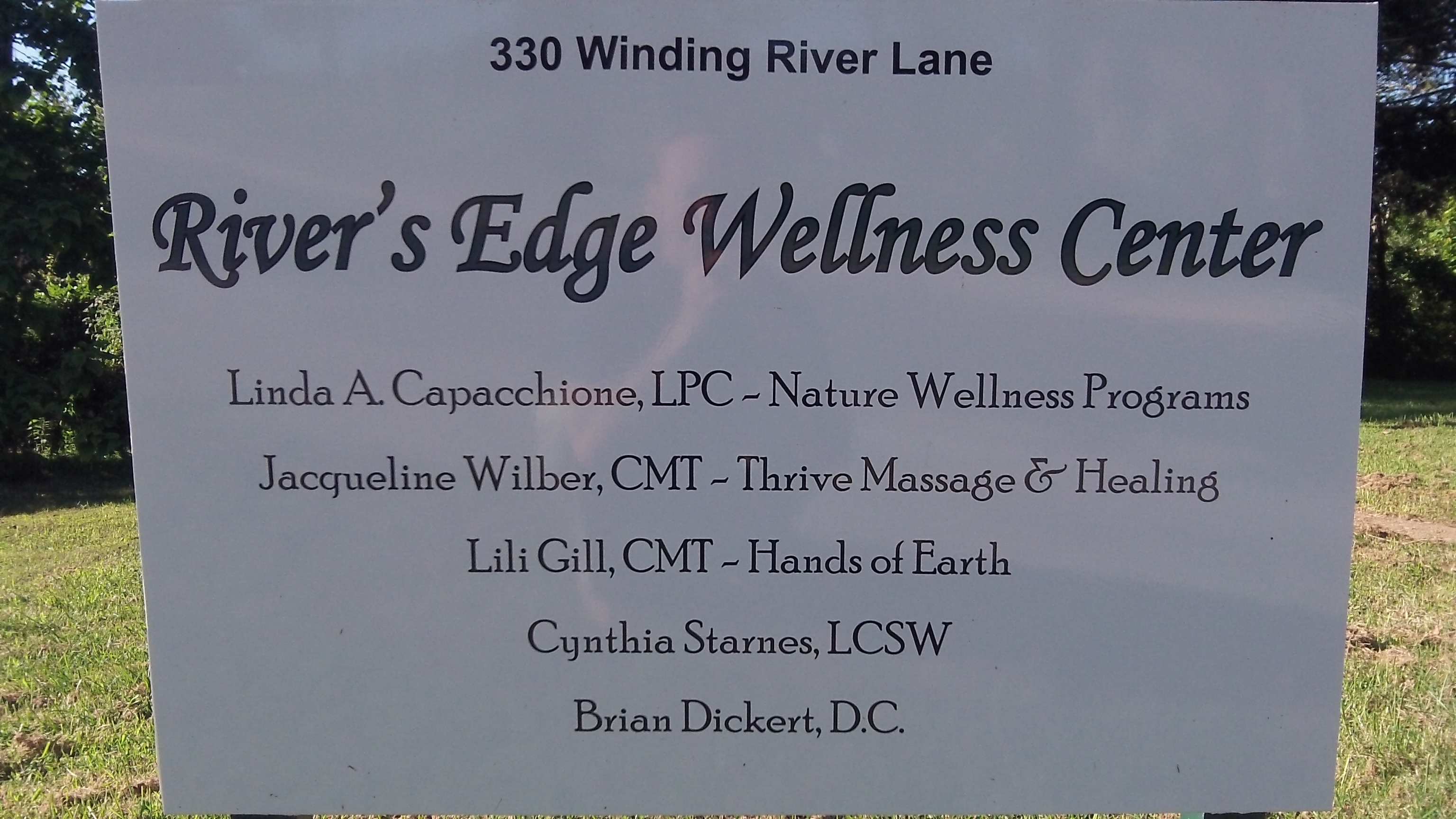
The practitioners at River’s Edge Wellness Center are hosting an open house on Friday, September 27th from 4-6:15PM.
https://www.facebook.com/events/163398963851145/

Meet the practitioners, learn about their wonderful therapeutic specialties, and have some freshly made juice and food ~ FREE!
Fresh juices will be made by The Juice Laundry!
WHEN: Friday, September 27th from 4:00 pm – 6:15 pm
FREE Talks, Demonstrations, and Discussions:
4:30 Linda Capacchione ~ Walking and Sitting Meditation &
Meditative Journaling in Nature
4:55 Brian Dickert ~ The 12 Stages of Healing
5:20 Jacqueline Wilber ~ Healing with Ayurveda
5:40 Lili Gill ~ Massage Modalities for Specific Health Issues
We hope you can join us for this
fun and healthy start to your weekend!
River’s Edge Wellness Center
330 Winding River Lane
Charlottesville, Virginia 22911
What can you expect with your first Entrainment?
In this short video of a Network Spinal Analysis Entrainment I describe what you can expect.
Join me for a Free introduction to Somato Respiratory Integration
https://www.facebook.com/events/1374451276107949/
Saturday, July 20th, 2 PM – 5 PM
Location:
Divine Play
The 12 Stages of Healing/Somato Respiratory Integration Workshop
Saturday, July 20th 2-5 PM
Where: Divine Play
Free
Somato Respiratory Integration (SRI) exercises are designed to help the brain reconnect with the body and its experience. The goal of SRI is to help you develop lifetime skills, safety, strength, wisdom and love in relationship to the experience of your body, its vibration, structure and energy.
The principle of healing inherent in the 12 Stages of Healing is to be where you are, rather than avoiding or attempting to be somewhere else in the journey. Through reconnecting you through breath, touch, focused movement and attention, you are able to experience your body more fully and instantly shift your state of consciousness to one that supports trust for your body-mind and life experience.
Once you learn how to amplify the rhythms inherent in our humanity you’ll have a powerful system for directly harnessing the internal forces of your body for easier self-healing, transformation and reorganization.
These rhythms are already within you. By focusing your breath, awareness and movement you can fully “be” in the rhythm and receive the wisdom inherent in each state of consciousness. Once you know the states, you can observe where you are on your journey. You can then choose which state best serves your journey at the moment. Most people find that regularly using the SRI exercises helps them feel more grounded and present, as well as more energized, confident and creative.
Dr. Brian Dickert has been studying SRI since 1995 and is excited to share these concepts.
Using songs, movies and fairy tales to show how different stages show up in our culture you will get a better sense of the messages your life is showing you.
Please bring a yoga mat or blanket to lie on.
This introduction is Free, and whether you attend or not you are invited to participate in a 21 Day SRI challenge, with free weekly conference calls with Brian Dickert.
SRI Challenge Information
This free program will kick off a 21 day SRI challenge. I will hold weekly conference calls to check in and answer questions. All that is required is a few minutes a day to check in to your breath & movement.
UberConference Number: (213) 992-5680
Open PIN: 86896
UberConference URL: http://www.uberconference.com/u/briandickert
Limit of 12 callers on the conference call – reserve your space today by e-mailing me:
brian.dickert.dc@gmail.com
Starting May 1, 2013 Dr. Brian Dickert will be practicing Network Spinal Analysis & Somato Respiratory Integration at 330 Winding River Lane, in Charlottesville, 1/10 mile from the Intersection of Rt. 250 and Rt. 20 (Stony Point Rd.).
It is a white house along the river in a peaceful setting.
To schedule an appointment call 434-227-7149
The holiday season can be a time of stress and rushing around.
Take this special opportunity to take care of yourself while helping others.
Sunday, December 2nd from 3-5 PM
1982 Arlington Boulevard, Suite 1
Call 434-227-7149 for details or an appointment
Dr. Brian Dickert will be donating $20 of every Network Spinal Analysis Entrainment to Children, Youth and Family Services of Charlottesville.

A recent article in the New York Times raises awareness of the harmful effects of “Energy” beverages. I can understand the need to feel energized to do a presentation, or get through a workout, or to just fight traffic in the morning.
Another question you may ask yourself is: Is there another way? I had plenty of energy as a kid without artificial stimulants, what is different now?
The first suggestion I would make to someone who feels the need for stimulants is to replace the simple carbs (white flour, white rice, white potatoes) and sugars in their diet with quality vegetables and healthy fats. What is missing in the former is nutrients, the latter contains vitamins, minerals and fatty acids which fuel your nervous system and brain.
Next, get moving! Movement is the key to energizing your body, and the benefits are long lasting and wide ranging.
Lastly, take care of your spine and nerve system. Stress is pervasive, when stressed we don’t always make the best decisions – especially with food. People under regular Network Spinal Analysis care report and improved ability to think and concentrate (without stimulants).
We all want to be present, alert and full of energy. You can have this, and be healthy too by taking care of your body and giving it what it needs.
For a free consultation to find out how you can breakthrough to a new level of health and well being call:
Brian Dickert, D.C. 434-227-7149
This is my story of my first visit to a chiropractor.
What if your life changed from having a healthy, flexible spine and nerve system?
This video is from Dawn Sea Kahrs in Wheeler, Oregon. You can find her story here: http://www.gracefulwaveschiropractic.blogspot.com/2012/09/last-posture-screening-of-summer-this.html
Call today to schedule an appointment – 434-882-0095
You also, can have more joy in your life!
“A central tenant of Network Spinal Analysis is that change rarely comes directly from the area in the body that is defensive, guarded and wounded. Instead, it comes after the individual becomes aware of the area where resources exist. Meaningful change comes when a place of connection is brought to awareness and “inspires” or entrains other parts of the system.”
Reorganizational Healing: A Paradigm for the Advancement of Wellness, Behavior Change, Holistic Practice and Healing. Volume 15, Number 5, P. 477
When your nervous system cannot adapt to current stress and energy demands, the spine, muscles and vertebrae are locked into a limited range of expression. The Spinal Entrainment contact, unique to Network Spinal Analysis, allows the nervous system to “reset” and reorganize through spinal awareness.
The reorganization of the nervous system is demonstrated by improved posture, more energy, wider range of emotions expressed. Lifestyle changes including: change in diet and exercise habits, change in long term behavior like career or a relationships. All these findings and more have been associated with those receiving Network Spinal Analysis Care.
Eat Good Fats, Be Healthy!
By Dr. Brian
I recently read Eat Fat, Look Thin, by Bruce Fife, N.D., and Tim Ferriss’s book, The 4 Hour Body and with the help of those books I’ve made changes in my diet that had been relatively the same for over 20 years.
Before I talk about what I changed, I should begin with what I was eating and why I ate it. In 1989 I started cycling for recreation and racing. The conventional wisdom at the time was for distance athletes to consume large portions of carbohydrates to fuel sustained efforts from long training rides. I didn’t eat processed foods, but over the years my consumption of healthy oils and fats like butter and olive oil became fairly low. I ate a vegetarian diet that consisted of around 65% carbohydrates, 20% protein and 15% fat, a diet that would fit in with the recommendations of Dr. Dean Ornish or the American Heart Association.
The AHA recommendations are based on the theory, introduced in the late 1950’s by Ancel Keyes, that a diet low in fat, specifically saturated fats will reduce the risk of artery disease, heart attack and stroke. Following their recommendations, if you remove dietary fat, you should lower your risk from heart attack and stroke.
As many people changed their diets, vegetable oils became popular. In the 1980’s manufactured “low-fat” foods and “no-fat” foods became available. In Eat Fat, Look Thin, Fife states, “from 1910 to 1970 butter consumption fell from 17 pounds per person each year, to 4 pounds. During the same period, consumption of “healthy” vegetable oils (margarine and shortening) increased 400%.”
Ancel Keyes’ “lipid hypothesis” of disease has some good points, but it is not a complete picture. It doesn’t account for cultures that eat high amounts of saturated fats but have little incidence of heart disease, and it doesn’t explain the high incidence rates of heart disease and stroke even though dietary consumption of fat has decreased over the last 40 years from 40% to 32% of total calories.
What the lipid hypothesis didn’t take into account was a sharp rise in mechanically processed foods starting in with the industrial revolution. Sugar, white flour, and pre-prepared foods were now more readily available. Also, the consumption of rancid, heated or processed oils, now known as “trans fats” increases systemic inflammation which increases heart disease and stroke (even if the oil starts out as a “healthy oil”. Meanwhile other cultures that didn’t have the advancements of the industrial revolution just kept eating the same diet they had been for thousands of years, and their rates of disease stayed the same.
About the time Keys was promoting his lipid hypothesis, others were promoting different ideas. Researchers Alan Kekwick and Gaston Pawan found that when overweight participants of a study were given calorically similar diets that differed in protein, fat or carbohydrates the ones on the high carbohydrate diets gained weight, but those on high protein or high fat diets lost weight.
A more recent study at Harvard Medical School used two groups of people on calorically similar diets, but one had 35% of the total calories from fat, the other 20%. What do you think the results were? The ones who ate more fat lost an average of 9 lbs., and the other group, they gained an average of 6.3 pounds, which is a difference of 15 pounds!
Fats Are Important
Fats make up the membrane of the cell – the outer shell that holds it together. Your brain is composed of 60% fat and cholesterol. Dietary fats are used to make hormones that control body functions. Vitamin D, estrogen, progesterone, testosterone, and DHEA are made from cholesterol. Hormones are the main regulators of metabolism, development, reproduction and many other processes. In addition, a diet lacking in fat can reduce the efficiency of your immune system and make your more susceptible to disease.
Starting in the 1960’s, saturated fats got a bad reputation and the market for vegetable oils skyrocketed. Did your parents have a large vat of Crisco too? Vegetable oils are high in poly-unsaturated fats, and they are made mostly from seeds like sunflower, safflower, canola and vegetables like soybeans and corn. Extracting oils from seeds and vegetables was almost impossible without the utilization of the hydraulic press. Vegetable oils have only been a part of the human diet for less than 150 years.
Conversely, coconut, palm, butter, tallow, olive oil and lard are high in saturated fats. They have been a staple in the diet of civilizations for thousands of years. To this day if you go to rural Pakistan you will find people using butter and goat fat, in rural China: lard, India: ghee, and in Italy and Greece: olive oil.
On the islands of Pukapuka and Tokelau in the South Pacific you will find people who, for the most part, are isolated from Western culture and influence. Their native diet remains what it has been for centuries. The standard diets on both islands are high in saturated fat derived from coconuts. Every meal contains coconut in some form, from green coconuts for drinking, the meat of the coconut, and coconut oil for cooking. In the 1960’s a long term health study was completed on the islanders, and despite a diet high in saturated fats the population of 2,500 was found to be healthy. Some of the findings of the study were:
They weren’t following the American Heart Association guidelines of 30% of calories from fat, and no more than 10% should be saturated. The islanders obtained close to 60% of their calories from fat, most of it in the form of saturated fats from coconuts. Ian Prior, M.D., one of the researchers stated, “Vascular disease is uncommon in both populations and there is no evidence of the high saturated fat intake having a harmful effect in these populations.” Other islanders who left for New Zealand were also tracked and Dr. Prior commented, “The more an islander takes on the ways of the West, the more prone he is to succumb to our degenerative diseases…gout, diabetes, atherosclerosis, obesity, and hypertension.”
A saturated fat is one that has no double bonds between the individual carbon atoms. This makes it less prone to going rancid and forming trans-fats. Oils higher in poly-unsaturated fats go rancid easier, in the presence of air, heat or light. This is why it is important to keep oils, especially olive oil in your refrigerator.
High fat diets – are they good or bad? What do you do when faced with opposing health information? Use your body as a guide. How do you feel? Do you have energy in the morning? If you wanted to sprint 100 yards to beat an impending downpour, could you? Have you had your blood values tested lately? Take your body measurements: weight, body fat percentage. These will all tell you if you are on the right track.
What do I eat now? Since reading The 4 Hour Body, I have significantly lowered the amount of carbohydrates I consume in a day. To make up for the loss of calories I am eating more eggs, and more fat in the form of butter and coconut oil. I’ve lost 5 pounds and have stayed there for 5 months, and I’ve lost an inch from my waist.
The change in my body I’m most impressed with is one I didn’t realize was a problem. In 2006 when we moved to our new house I over-worked my body and it took its toll on my hands; you could say I was having “arthritis” symptoms: painful, swollen hand joints. I didn’t think it was serious, and after the initial “flare-up” in 2006 it improved, but another episode would occur if I used my hands a lot when engaging in an activity like gardening or waxing the car. For the most part I became used to my hands being a little bit sore and stiff all the time. About two months into the diet change I noticed my hands were moving more freely, and the joints didn’t look as swollen and enlarged.
How will you know your diet is working for you? Within a couple months of adding healthy oils to your diet and removing vegetable oils, you should notice a difference in energy, weight, body dimensions, body fat, and joint mobility. I’ve combined healthy oil intake with an increase in protein and I haven’t felt this great in years.
Keys to Good Health with Healthy Fats:
12/23/2011 Update:
For a more scientific article from Dr. Ron Rosedale on the importance of eating good fats, read this article: http://training.tonyrobbins.com/1513/the-truth-about-weight-loss-hormones-prescription-drugs-and-your-health/
When you combine stubbornness with improper form it can lead to an injury. Ten days ago I was moving an area rug to a different room. This required removing all the furniture since the rug left only a foot of floor around all edges. I was getting impatient when I got to the filing cabinets and tried to lift them (while still full) and slide the rug underneath. In order to slide the rug while lifting I had to stand far away from the cabinet thus putting way too much strain on my back. Needless to say this wasn’t a good idea.
I did get smarter with the second filing cabinet and asked my son to slide the carpet while I lifted, but the damage had been done. Although, I didn’t know this right away. I still felt fine for the next few hours and continued my weekend chores. I cut the grass, worked in the garden, then I started moving some stones from the stream bed to the stream bank. Within minutes I was getting nauseated and felt pain in my mid back, I had done way too much.
At this point what would a chiropractor do to “fix” their injured spine?
Before I answer those questions, it should be known that this wasn’t the first time I’ve injured this area of my spine, although it had been many years since it had bothered me.
This area of my spine was painful a couple times of year in my mid twenties, then about 10 years ago after being in practice for a few years I noticed my spine was sore after a full day of work. I realized I had poor mechanics when working with people, and my body had become weak from a lack of exercise. I had no interest in a temporary fix from a pain reliever just so I could re-injure myself again from using the same poor mechanics with a weak core.
As I was writing this I saw this post from Donald Epstein, which explains what I was thinking ten years ago, and what I was also thinking this past week.
Each moment the question is the same..Do I wish to go BACK to my familiar life and be restored, or do I choose to go beyond anything before?
I noticed a pattern in my life and took steps to make my body stronger than it ever was. I started doing Pilates exercises and increased the frequency of my workouts. About this time I started attending J’s Gym, the first time in my life I consistently went to any gym, previously choosing to workout on my bike.
After a few months my back wasn’t an issue anymore and I was fit for the first time in my life. I didn’t have to protect my spine by limiting anything I did for fear of being in pain. I felt powerful in knowing I had changed my body and changed a harmful pattern of movement.
Now back to the present. Today I did my first full workout at the gym, everything feels great even after having a relapse over the weekend, here is what I did to “fix” myself:
I lived my life as normal as possible, I went to work, I tried to keep mobile, which included some indoor cycling and walking. My spinal care consisted of one Network Spinal Analysis entrainment more than usual (my usual is once a week). I wasn’t comfortable enough to do my twice a week yoga routine so I skipped this until yesterday. I also added this Egoscue Exercise to my normal routine, which I did for 10 minutes a day. (The Egoscue Exercises I have been doing for over 10 years, but had been skipping it lately).
A couple of days of the last week it was difficult to do anything because of the discomfort, so I rested much more than usual and did some reading, but I know with the way I train my body I would be able to recover quickly. I also knew I wouldn’t need any extra help, this included pain relievers, ice/heat, gels, or manipulation of the “stuck” area. I had full confidence in my bodies’ ability to self regulate it’s own tension, and I also knew the pain was protection, the pain prevented me from doing too much. I didn’t want to artificially “feel better” until the tissues, muscles, tendons and ligaments actually were better.
I know this isn’t the path most people take, even most chiropractors, but it is the one that works for me. I know I am listening to my bodies’ cues. I am not ingesting anything that is harmful to my body or dulling my senses. Ultimately I come out of the process more inspired with how my body heals.
You’re getting on my nerves!
By Dr. Suzanne
Everyone knows what it means when someone says “you’re getting on my nerves,” but I find it an interestingly and curiously anatomically accurate phrase. Consider this:
We perceive our world through our nerves, or nervous system. We not only coordinate the function of every cell, tissue and organ in the body, but also express every emotion through our nervous systems. It’s the part of us we use to reason, to adapt to stress, and it’s the vehicle we use to create our conscious reality. The nervous system is also designed to keep us safe from perceived danger.
When our nervous systems are not flexible enough to integrate an event, or adapt to a stressor, the event or stressor is perceived as overwhelming, and we move into a natural protective response – stress physiology. The energy and information of that overwhelming event or trauma is translated into vibration and tension, which is then stored in our bodies to be digested or integrated later when it is safe, resulting in defense posture.
In defense posture, we tighten; we hunker down in a hostile world. Our blood pressure tends to rise, we feel less emotion and we live in reaction to every moment. Over time, defensive posture distorts the spinal system. Muscular tightness and spasm, and reduced breath into the effected areas occur, and reduced motion and movement results. Spinal bones lose their normal alignment as the muscles and ligaments strain and pull. Nerves can become compressed or stretched and irritated which results in abnormal function.
This is the time when we find things get on our nerves. Before we know it, everything – even little stuff – seems overwhelming. When we’re already stressed, we tense more easily, and until we move out of defense posture, the brain continues to perceive life defensively, and produces stress chemicals that inhibit not only our restorative functions, but also the ability to pay attention to the incomplete energy or “unfinished business” stored in the body. We’re “stuck” in defense.
Stuck in defense, we react to environmental challenges as threats. Novel or new ideas are stressful; we have difficulty making changes and we fear things that are different. We are in survival mode in many areas of our lives. This pattern of defense posture is held until the brain perceives it is safe to experience that original overwhelming energy again and digest or integrate the information from the trauma – to finish that unfinished business. That’s where Network Spinal Analysis care comes in!
Network care helps people move from the stress physiology that fixed them into defensive posture, into something new and better. Most of us remain in defense posture our whole lives. There are many people whose vertebrae, ligaments and tissues are so locked into stress patterns, creating so much tension, that their focus is on “just getting through another day,” instead of enjoying life.
Network care allows the brain to move from stress physiology into safety and growth. By using gentle and specific touches in a consistent sequence called the Network Entrainment, a person’s own body learns to release those complex patterns of stress, tension and defense. You cannot be in defense and growth at the same time. A brain in defense cannot develop new strategies for experiencing and responding to life. A brain in growth can.
In growth, we are more attentive to our inner cues, energy, and respiration and we are no longer focused on the outer circumstance of the moment to dictate our health and well-being. When we’re “entrained” to our internal rhythms, outside stressors affect us less, because we no longer entrain to the stress around us. Spinal tension patterns, alignment and postural changes all reflect our movement from defense to growth. We experience a greater sense of grace, gratitude, connection, inner power and love, all previously inaccessible to a brain that was functioning in defense.
Network Entrainments are designed and applied in such a way as to engage the higher part of the brain, through which we observe ourselves and make choices regarding our behavior. Instead of “fixing” you, Entrainments help your body find that old unfinished business, fully integrate it, and move forward from there utilizing that held tension as fuel for growth and healing.
Network care is about helping your body and nervous system reorganize, become more flexible and able to adapt, and to develop new strategies for not only releasing tension, but also experiencing life in a way that wasn’t available to you before. In time, this higher energetic, physical, and emotional state becomes more familiar and sustainable and people radiate authenticity, love and hope. And each time you are more fully “you,” not only is the world is a better place, but also it’s less likely to get on your nerves!
This article is from our April 2011 Newsletter, sign up to receive this newsletter when it is published by visiting www.eylc.com
Please note our holiday hours for the next two weeks:
Dec. 20th through Dec. 24th – Normal Hours in Charlottesville and Afton
Dec. 25th – Closed
Dec. 27th – Sample Night 7PM
Dec. 27th through Dec. 31st – Normal Hours in Charlottesville, Afton Closed.
No Yoga or Feldenkrais Dec. 28th
Jan. 1st – Charlottesville Closed
Jan. 3rd – Charlottesville and Afton Closed
Note this is a change in the previously posted calendar – the posted calendar has been corrected.
This has also been posted on our homepage.
www.eylc.com
 Corrales Chiropractic
You must be logged in to post a comment.